
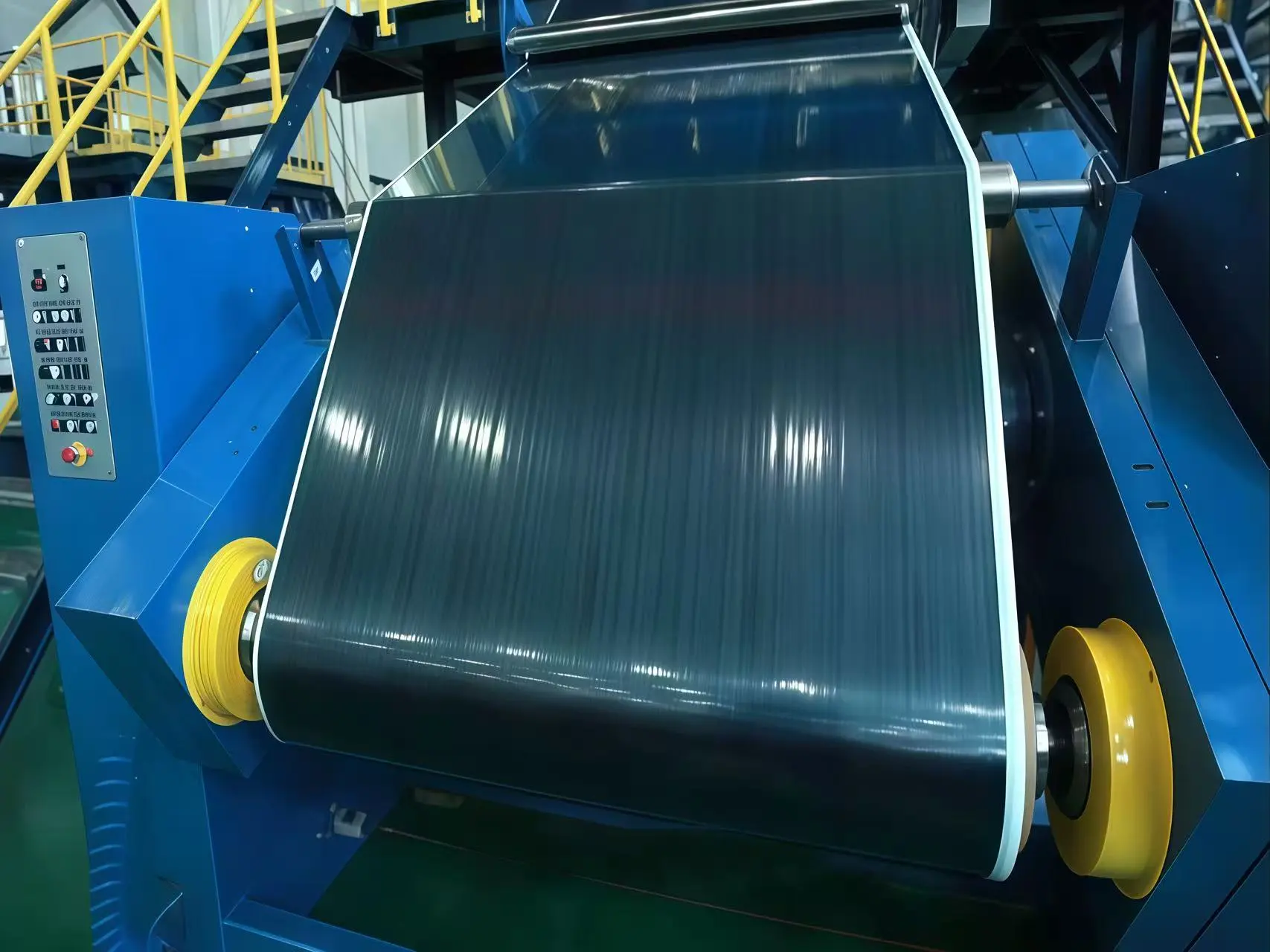
Unidirectional Carbon Fiber Prepreg
Fully customizable OEM solutions for unidirectional carbon fiber prepreg. High-modulus prepreg materials available from ISO-certified carbon fiber prepreg manufacturers.
View productThis hub is built for one job: turning the OSB catalog into a shortlist. Whether you are comparing carbon fiber material suppliers for a first production run or simply need to pin down a ply thickness before tooling is cut, the tables and decoder below start from the part and work back. Every model number in the catalog resolves to a specific combination of fiber grade, areal weight, weave and tow width, so a carbon fiber spread tow fabric can be matched to your laminate rather than guessed at.

Start from the part, not the datasheet. The catalog does not hide behind a single SKU: it lists dozens of distinct grades — OSB CFF65 P 25, OSB CFF133 P 12, OSB CFF206 P/T 16 — and each one pairs a fiber grade with an areal weight, a weave structure and a tow width. Choosing between them is a design decision, and it is the decision this page is built to support.
The technology behind the choice is straightforward. In spread tow fabric, the filament tow is opened into a flat, wide band before weaving. The product page states that this produces excellent fiber alignment and fewer warp–weft interlacing points, which reduces resin accumulation and porosity during prepreg processing and enables easy impregnation and laying. Composites manufactured with this fabric are described as showing superior interface performance and high mechanical properties, with design flexibility for final composite parts.
Everything below is a working tool rather than a brochure. The decoder explains what each character in a model number means, the master table lists every grade in the catalog with its reference thickness, and the scenario matrix converts a part requirement into a shortlist you can take straight to a sample request.
Every OSB fabric is named with the same four-part logic. Read it once and the entire specification table below becomes scannable.
Carbon Fiber Fabric — the product family prefix on every listed model.
Fiber areal weight in g/m² (gsm). In CFF80 it is 80 gsm.
Fabric structure code — here P stands for plain fabric.
Width of a single spread tow, in mm (or as specified).
Plain weave — the structure shown by a single P in a model number.
Twill weave — listed alone or alongside P where the model offers a choice.
Satin weave — appears with P/T on models such as OSB CFF80 P/T/S 20.
* Thin-ply featured product. Any fiber areal weight marked with an asterisk in the table is flagged on the product page as a thin-ply featured product. A model without the asterisk is listed at its standard weight — the asterisk is a catalog rule, not a performance claim about the fiber grade.

OSBing supplies this family as ultra-thin dry fabric woven from high-performance Toray fiber, in a standard 1000 mm width. The catalog covers standard-weight constructions from 52 g/m² up to 206 g/m² and thin-ply grades across the T300-3K, T700-12K, T800-12K, T800-24K and M30 groups.
Filter by fiber grade, then read across for areal weight, structure, tow width and reference thickness. This is the raw catalog — no interpretation is added inside the table.
| Description | Fiber Areal Weight (g/m²) | Fabric Structure | Tow Width (mm) | Reference Thickness (mm) |
|---|---|---|---|---|
| T300-3K Grade Carbon Fiber | ||||
| OSB CFF80 P 5 | 80* | Plain Weave | 5 | 0.08 |
| OSB CFF100 P 4 | 100* | Plain Weave | 4 | 0.10 |
| T700-12K Grade Carbon Fiber | ||||
| OSB CFF65 P 25 | 65* | Plain Weave | 25 | 0.07 |
| OSB CFF80 P/T/S 20 | 80* | Plain / Twill / Satin Weave | 20 | 0.08 |
| OSB CFF80 P 25 | 80* | Plain Weave | 25 | 0.08 |
| OSB CFF88 P/T/S 18 | 88* | Plain / Twill / Satin Weave | 18 | 0.09 |
| OSB CFF100 P/T 16 | 100* | Plain Weave / Twill Weave | 16 | 0.10 |
| OSB CFF100 P/T 20 | 100* | Plain Weave / Twill Weave | 20 | 0.10 |
| OSB CFF133 P 12 | 133* | Plain Weave | 12 | 0.13 |
| OSB CFF160 P 10 | 160 | Plain Weave | 10 | 0.16 |
| OSB CFF200 P/T 8 | 200 | Plain Weave / Twill Weave | 8 | 0.20 |
| T700-24K Grade Carbon Fiber | ||||
| OSB CFF132 P 25 | 132 | Plain Weave | 25 | 0.13 |
| OSB CFF165 P/T 20 | 165 | Plain Weave / Twill Weave | 20 | 0.16 |
| OSB CFF183 P 18 | 183 | Plain Weave | 18 | 0.18 |
| OSB CFF206 P/T 16 | 206 | Plain Weave / Twill Weave | 16 | 0.21 |
| T800-12K Grade Carbon Fiber | ||||
| OSB CFF100 P 10 | 100* | Plain Weave | 10 | 0.10 |
| OSB CFF100 P 9 | 100* | Plain Weave | 9 | 0.10 |
| T800-24K Grade Carbon Fiber | ||||
| OSB CFF83 P 25 | 83* | Plain Weave | 25 | 0.08 |
| OSB CFF103 P 20 | 103 | Plain Weave | 20 | 0.10 |
| OSB CFF114 P 18 | 114 | Plain Weave | 18 | 0.11 |
| OSB CFF130 P 16 | 130 | Plain Weave | 16 | 0.13 |
| OSB CFF206 P 10 | 206 | Plain Weave | 10 | 0.21 |
| M30 Grade Carbon Fiber | ||||
| OSB CFF52 P 20 | 52* | Plain Weave | 20 | 0.05 |
| OSB CFF61 P 25 | 61* | Plain Weave | 25 | 0.06 |
| OSB CFF65 P 16 | 65* | Plain Weave | 16 | 0.07 |
| OSB CFF76 P 20 | 76* | Plain Weave | 20 | 0.08 |
| OSB CFF84 P 18 | 84* | Plain Weave | 18 | 0.08 |
| OSB CFF95 P 16 | 95* | Plain Weave | 16 | 0.10 |
All fabric products listed in this table have a standard width of 1000 mm. * indicates a thin-ply featured product. Fabric structure and other specific specifications can be customized according to customer requirements.
Four common starting points, each mapped to models that already exist in the catalog — with the question you should answer before requesting a sample.
The asterisk is the fastest filter in the table. Asterisked weights span 52 g/m² to 133 g/m² and are the company's thin-ply featured products. Everything from 160 g/m² upward in the T700-24K, T800-24K and high-weight T700-12K rows is listed without the asterisk.
Decision point: thin-ply buys you thickness control per ply, but it also means more plies, more lay-up time and a tighter cure window.
The structure code sits in the third position of every model number. Most of the catalog is plain weave. Twill and satin appear only where the row says P/T or P/T/S — at 80, 88, 100 and 200 g/m² in the T700-12K group.
Decision point: if your part is not flat, look at the multi-structure rows first; if the structure you need is not listed, it can be customized.
Tow width is stated for every model and runs from 4 mm (OSB CFF100 P 4) to 25 mm (OSB CFF65 P 25, OSB CFF80 P 25, OSB CFF132 P 25, OSB CFF83 P 25, OSB CFF61 P 25). It is recorded in millimetres or as specified.
Decision point: read tow width together with areal weight — the pair sets both the look of the weave and the reference thickness of the ply you are buying.
The catalog gives you the starting point; the order is built around the part. Fabric structure and other specific specifications can be customized according to customer requirements, and the listed 1000 mm width is the standard — not the limit — of what can be discussed.
Keep adjacent product options together for a faster catalog comparison.
Fully customizable OEM solutions for unidirectional carbon fiber prepreg. High-modulus prepreg materials available from ISO-certified carbon fiber prepreg manufacturers.
View product
Direct factory wholesale for carbon fiber bulk orders. We provide high-modulus, thermally conductive carbon fiber material for advanced industrial composites.
View product
High-Thermal-Conductivity Chopped Carbon Fiber: A product formed by cutting mesophase pitch-based carbon fiber tow to specified lengths; High-Thermal-Conductivity Carbon Fiber Powder: A powdered…
View productit decodes in four parts: cff stands for carbon fiber fabric, 80 is the fiber areal weight in g/m² (gsm), p indicates fabric structure as plain fabric, and 5 is the width of a spread tow in millimetres (or as specified).
p is plain weave, t is twill weave and s is satin weave. a model such as osb cff80 p/t/s 20 can be supplied in any of the three structures, while osb cff133 p 12 is listed as plain weave only.
all fabric products listed in the specification table have a standard width of 1000 mm. fabric structure and other specific specifications can be customized according to customer requirements.
fabrics marked with an asterisk (*) in the fiber areal weight column are the company's thin-ply featured products. asterisked weights in the current catalog range from 52 g/m² to 133 g/m².
yes. fabric structure and other specific specifications can be customized according to customer requirements. share your target areal weight, weave code, tow width and required width through the contact page and the specification can be set against your drawing.
the table is grouped by t300-3k, t700-12k, t700-24k, t800-12k, t800-24k and m30 grade carbon fiber. t700-12k carries the widest spread of areal weights, from osb cff65 p 25 at 65 g/m² up to osb cff200 p/t 8 at 200 g/m².